What is an HRMS, and What Are Its Benefits for Businesses?

Daftar Isi
In Singapore’s fast-paced commercial environment, human resource management is getting increasingly complicated. Companies desire efficiency and smarter choices, which frequently begin with the question “What is HRMS?” Specialized technology helps simplify operations and strengthen decision-making.
According to GoBusiness, the Enterprise Singapore (EnterpriseSG)-supported HRMS solution provides up to 50% support for SMEs, allowing them to optimize their HR operations. In Singapore’s fast-paced commercial climate, specialist technology helps to streamline processes and improve decision-making.
This article defines an HRMS, discusses why it is important for business growth, and demonstrates how it can improve workforce management. Companies that use HRMS benefit from superior structure, data-driven insights, and the ability to adjust in a competitive market.
 Key Takeaways
- A Human Resources Management System is a vital software suite for automating and integrating core HR functions into a single, unified platform.
- For Singaporean businesses, an HRMS is crucial for maintaining compliance, improving operational efficiency, and making data-driven strategic decisions in a competitive market.
- The key functions of an HRMS include centralized data management, payroll, recruitment, performance tracking, and employee development, which all work together.
- Implementing an HRMS offers significant benefits, such as increased accuracy in HR processes, an enhanced employee experience, and better overall business intelligence.
- ScaleOcean’s HRMS provides an all-in-one solution to manage your HR operations, helping you overcome administrative burdens and focus on strategic growth.
What is a Human Resources Management System (HRMS)?
The Human Resources Management System (HRMS) is software that integrates numerous technologies to manage and automate HR processes. It centralizes all employee data and HR activities, making everything from payroll to performance management easier to handle.
An HRMS system integrates various HR functions that were previously handled with paperwork or separate software. This integration helps create a smoother, more efficient workflow for managing your people. So, what is an HRMS system? It’s the key to streamlined HR operations.
Why is HRMS So Important for Singaporean Businesses?
Singapore’s business environment is really competitive and moves so fast, which means that being efficient isn’t just an option. It’s everything. An HRMS, often known as a human resource management system, helps quite a bit here. It handles routine tasks, allowing your HR team to focus on more strategic initiatives, including the Human Resource Planning (HRP) process.
Beyond that, Singapore actually has these quite specific labour laws and regulations, ones that businesses really must adhere to without fail. An HRMS, often referred to as an HRMS system, is key here, helping to ensure compliance by automating tracking and reporting.
Who Uses HRMS?

When you think about an HRMS system, you naturally picture the HR department as the main users, right? They absolutely lean on it for everything from payroll to recruitment and even performance tracking, making it their central, go-to tool for almost every administrative function in the business.
An HRMS brings together functions that were once handled with paperwork or separate systems. So, what is HRMS in HR? It integrates processes, creating a smoother and more efficient workflow for managing your people.
Key Differences of HRMS, HRIS, and HCM
It’s really quite common, you know, for the terms HRMS, HRIS, and HCM to be used interchangeably, which definitely can cause some confusion, where understanding these distinctions becomes pretty important. Here’s a simple breakdown of what sets them apart:
- Data Management: HRIS organizes and stores personnel data. HRMS goes a step further, managing HR procedures such as payroll and benefits. However, HCM also encompasses strategic personnel management, optimizing overall employee performance, and aligning with company needs.
- Core Functions and Features: HRIS organizes fundamental HR functions, including employee data storage. HRMS expands on this with capabilities such as payroll and benefits management. HCM includes strategic tasks like performance management, personnel development, and succession planning.
- Operational vs. Strategic Focus: HRIS and HRMS are concerned with operational tasks, including the efficient administration of daily HR processes. In contrast, human capital management takes a strategic approach, focusing on long-term employee growth, performance, and talent alignment with organizational goals.
- Talent Management Scope: HRIS typically lacks talent management functions and focuses solely on data storage. HRMS contains various talent management capabilities, such as benefits. HCM provides a comprehensive approach that combines strategic talent management, succession planning, and development.
- Long-Term Growth: HRIS and HRMS increase efficiency by streamlining procedures. HCM, on the other hand, focuses on creating long-term corporate growth by cultivating people, expanding employee capacities, and aligning worker skills with overall organizational goals in order to achieve sustained success.
Key Functions of a Modern HRMS
A modern HRMS, really, it’s far more than just a place to store files. Think of it more as a central engine for handling your entire workforce operations. This comprehensive human resource management system brings together a lot of essential functions into one coherent system. Here are the key functions of a modern HRMS:
1. Centralized Employee Data Management
When you look at an HRMS, one of its core strengths is offering a single, secure place for all employee information, really cutting down on all those scattered spreadsheets and piles of paper files. This central spot makes sure your data is consistent, always up-to-date, and available to the right people when they need it.
Keeping all this important information in one spot really does a lot for improving both data accuracy and overall security. It also, quite practically, simplifies creating reports and getting valuable insights into your entire workforce, since this particular function is essentially the very foundation upon which all other HRMS features are built.
2. Payroll & Benefits Administration
Automates payroll processes, salary computations, and benefits enrollment to ensure compliance with Singapore’s CPF payments. An HRMS eliminates the possibility of human error by processing complex computations, saving time, and maintaining payroll accuracy.
Beyond pay, HRIS streamlines benefits, including insurance and retirement, by handling enrollments, eligibility, and contributions. It also simplifies payroll compliance by using automation to address complex requirements such as corporate tax in Singapore.
3. Time and Attendance Tracking
Manually tracking staff hours, leave, and attendance is error-prone and creates a significant administrative load. An HRMS system automates these activities by allowing employees to clock in and out digitally and request time off via a self-service portal, resulting in reliable data.
This automation saves time while ensuring compliance with MOM rules. The HRMS system quickly handles shift changes, overtime, and leave rules, offering a clear, auditable record of employee work hours, resulting in seamless and accurate payroll management.
4. Recruitment and Onboarding
A really effective HRMS typically comes with an Applicant Tracking System, or ATS, built right in, which is fantastic for streamlining the whole recruitment process. It lets you post job openings, handle applications, and keep in touch with candidates all from one place, making the entire hiring workflow significantly more organised and efficient.
Once you’ve got your new hire, the HRMS then smoothly steps in to facilitate a great onboarding experience. It automates things like sending offer letters, getting all that initial new hire paperwork collected, and setting up their first training, which genuinely helps new employees feel welcomed and able to become productive more quickly during the employee onboarding process.
5. Performance Management
For performance management, a modern HRMS really offers up a solid set of tools to support that entire lifecycle. Both managers and employees can use the system to set goals, keep tabs on progress, and conduct performance reviews, creating a far more structured and continuous approach to evaluating employee performance.
This particular function is great for helping to build a real culture of feedback and ongoing improvement within the company. By carefully tracking performance data over time, you can quite easily spot your top performers, figure out where skill gaps might be, and make more informed decisions about things like promotions and compensation.
6. Compliance Management
Compliance with Singapore’s labor standards and PDPA can be difficult for businesses. According to IMDA, consent is not required for managing employment connections, such as work schedules, but employees must be notified in accordance with the PDPA. An HRMS streamlines record-keeping and ensures compliance.
The technology also sends alerts for important deadlines and policy modifications, proactively lowering the chance of noncompliance penalties. This strategy provides peace of mind by ensuring that your HR data is kept safe and in accordance with legal regulations.
7. Training & Development (L&D)
It’s a well-known fact that supporting your employees’ growth is absolutely key if you want to retain top talent in today’s market. Many HRMS solutions come with Learning and Development (L&D) modules that really help you manage training programs and keep an eye on employee progress.
This whole approach really makes sure your employees have all the skills they need to not only succeed in their current roles but also grow right along with the company, which is invaluable. It also simplifies identifying specific training needs and helps you measure the actual return on investment for your L&D initiatives.
 Also Read: Human Resource Management: Key Practices for Business
The Top Benefits of Using an HRMS
An HRMS goes beyond automation to provide tangible benefits such as time savings, cost savings, and increased employee morale. It is a strategic investment that will benefit numerous company segments and drive long-term success. Here are the main advantages of adopting an HRMS:
1. Increased Efficiency
When an HRMS, or human resource management system, automates those repetitive, time-consuming HR tasks, things like payroll, tracking attendance, and all that data entry, it really frees up your HR team. This means they can finally move away from just administrative duties and put their focus on more strategic, important initiatives.
This kind of efficiency doesn’t just stop with HR, though. It really spreads throughout the entire organization. With processes being much more streamlined, approvals happen faster. Information is more readily available for everyone, reducing typical administrative bottlenecks across departments.
2. Improved Accuracy
Let’s be honest, manual data entry is a big source of errors in HR, often leading to real problems with payroll, compliance, and even reporting. An HRMS system really helps minimize this risk, mainly by automating data collection and calculations, which makes sure your HR data is genuinely accurate and reliable.
Greater accuracy means fewer payroll mistakes and better compliance with regulations. Reports become more trustworthy overall. This builds confidence in your HR processes and cuts down on time spent correcting errors. Importantly, it reduces the significant hidden cost of fixing mistakes.
3. Better Decision-Making
One of the great things about an HRMS is how it gives leaders access to real-time data and some pretty powerful analytics tools. You can easily generate custom reports on key metrics, such as employee turnover, recruitment costs, or even workforce demographics.
Instead of relying on guesswork, you can use solid data to spot trends, anticipate challenges, and plan for what’s ahead. This data-driven approach is essential for navigating today’s business complexities. It helps turn your HR department into a strategic business partner by staying ahead of the latest HR trends and aligning workforce strategies with business goals.
4. Enhanced Employee Experience
Employee self-service portals are a really standout feature of modern HRMS platforms these days. They essentially put employees in control of their own information, letting them request leave, view payslips, and update personal details when it suits them, which often leads to a much more positive employee experience.
It’s pretty clear that when employees can easily get the information they need and processes are transparent, both satisfaction and engagement usually go up. Understanding the benefits of HRIS really means creating a better work environment, and a good HRMS absolutely shows that you value your employees’ time and truly invest in their convenience.
5. Centralized Information
Having one single source of truth for absolutely all HR-related information is, frankly, a massive advantage for any business. It essentially eliminates data silos. This ensures everyone is working with the same, most up-to-date information. It is crucial for effective and coordinated management.
Whether you’re looking for an employee’s contact details or a company-wide policy. An HRMS ensures everyone knows where to find it instantly. This centralization makes reporting simpler. It definitely improves security and ensures that critical information never gets lost. It truly becomes the foundation for a well-organized HR operation.
How to Choose the Right HRMS for Your Business
Choosing the correct HRMS for your company is an important choice that affects the entire organization. Begin by reviewing your current HR practices to identify the issues you’re experiencing. An HR strategy example can highlight gaps in your system and guide you in choosing the right solution. These steps will help you identify the finest option.
- Assess your business needs and cost implications: Understand the issues your organization faces in HR operations, and then determine how much you can invest in an HRMS. This enables you to choose a system that meets your individual requirements and budget, resulting in the best ROI.
- Prioritize a robust ESS system: An HRMS with ESS allows employees to update personal information, view pay stubs, and request time off. This saves HR workload, boosts efficiency, and raises employee happiness by giving them greater control.
- Ensure integration with existing systems: Choose an HRMS that is compatible with your existing software, such as payroll or accounting systems. Integration ensures that data flows smoothly, reduces errors, and avoids disruptions in established business processes.
- Ensure the system is scalable: As your company expands, so should your HRMS. Choose a system that can manage more personnel data and offer additional HR services. This will allow you to extend operations without replacing the system.
Manage Your HR Operations with ScaleOcean’s HRMS
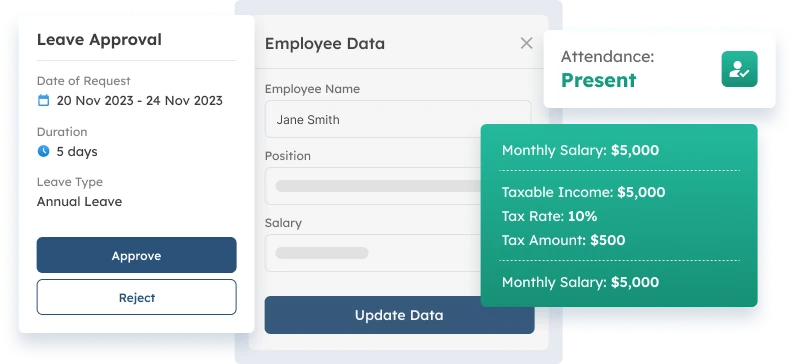
ScaleOcean’s HRMS assists organizations by automating payroll, attendance, and performance management, which reduces human labor and ensures compliance. It minimizes administrative chores, gives useful insights, and boosts employee engagement, transforming human resources into a company growth engine.
ScaleOcean also offers a free demo to help you explore its potential, with further assistance from the CTC Grant to reduce implementation expenses. This ensures compliance, efficiency, and more effective HR operations. Here are the main characteristics of ScaleOcean software:
- Complete HR Automation: Automates payroll, attendance, and performance to reduce manual work, boost accuracy, and ensure compliance.
- Customizable HR Modules: Tailor dashboards and workflows for each division with advanced HR module customization.
- Unlimited Users, No Extra Cost: Add unlimited users without extra fees, ideal for growing teams and large-scale HR operations.
- Integrated All-in-One Solution: Connect HR with finance, inventory, and more for seamless data flow across departments.
- Flat & Transparent Pricing: Enjoy enterprise-level HR tools with flat, predictable pricing, no hidden costs or user-based fees.
Conclusion
A human resource management system is more than just software. It is a key asset for Singaporean firms. By centralizing data, automating HR tasks, and providing real-time insights, businesses can improve efficiency, accuracy, and long-term success.
ScaleOcean provides full HR solutions, including payroll and performance management. Companies that use ScaleOcean’s HRMS system benefit from automation, compliance, and analytics, which improve workforce management. Investing in this system means positioning your company for long-term success.
FAQ:
1. What is HRMS used for?
HRMS (Human Resource Management System) is designed to simplify and automate various HR processes. This includes employee data management, payroll, recruitment, performance evaluations, work schedules, and benefits administration.
2. What is an example of HRMS?
A popular example of HRMS is Workday. It offers cloud-based HR software that integrates multiple HR functions. These include payroll, talent management, and employee performance tracking, all accessible in one unified system.
3. What are the 7 main functions of HRM?
The key functions of HRM include:
1. Recruitment and Staffing
2. Employee Training and Development
3. Compensation and Benefits Management
4. Managing Employee Performance
5. Maintaining Employee Relations
6. Ensuring Legal Compliance
7. Promoting Workplace Health and Safety
4. What is the difference between HRIS and HRMS?
The key difference between HRIS and HRMS is scope. HRIS focuses on storing and managing employee data. HRMS goes beyond by automating and integrating additional HR functions. These include payroll, recruitment, and performance management.